Follow this scalable fleet operations guide to streamline bookings, automate dispatch, boost revenue, and verify seamless operations in a competitive market.
Scalable Fleet Operations Guide for Optimized Bookings
Running a mid-sized charter fleet in Canada means every booking counts and lost reservations hurt your bottom line. Manual processes turn scheduling into a guessing game, while competitors rely on smarter digital tools to fill their vehicles and cut errors. By adopting automated fleet management, you replace outdated methods with instant capacity updates, accurate pricing, and secure payments, making every reservation a revenue opportunity instead of a risk.
Table of Contents
Step 1: Set Up Automation For Fleet Bookings
Step 2: Integrate Real-Time Dispatch And Pricing
Step 3: Optimize Revenue With Data Analytics
Step 4: Verify Operational Efficiency And Customer Experience
Quick Summary
Key Insight | Explanation |
|---|---|
1. Automate Booking Processes | Implement a booking platform to eliminate manual errors and streamline reservations, enhancing operational efficiency. |
2. Integrate Real-Time Dispatch | Connect tracking and dispatch systems for optimized routing and dynamic pricing, ensuring timely service delivery. |
3. Analyze Revenue Data | Leverage data analytics to identify performance trends and inform pricing strategies for maximizing revenue. |
4. Monitor Customer Satisfaction | Regularly gather and assess customer feedback to ensure service quality remains high and meets expectations. |
5. Focus on Operational Metrics | Consistently review key operational metrics to track efficiency improvements and address any emerging issues. |
Step 1: Set Up Automation for Fleet Bookings
Your goal here is straightforward: replace manual booking processes with automated systems that handle reservations instantly and accurately. When your team stops managing spreadsheets and phone calls, capacity becomes transparent, double-bookings disappear, and revenue stops leaking out the door.
Start by selecting a platform that integrates with your existing operations. Look for one that offers real-time availability updates, instant quote generation, and automated reservation confirmation. Your system should connect directly to your website so customers can book without calling your office.
Next, configure your vehicle inventory in the system. Input each asset with its capacity, features, and availability. The platform uses this data to automatically match customer requests to the right vehicle. When a client requests a charter, the system instantly checks what’s available and generates an accurate quote.
Then set up your pricing rules and dynamic rate structures. Automation should calculate quotes based on distance, vehicle type, time of booking, and demand. Real-time data integration through IoT and AI enables systems to optimize pricing and resource allocation automatically, reducing manual intervention.
Connect your booking confirmation workflow. Once a reservation is confirmed, automation should trigger driver notifications, dispatch assignments, and customer receipts simultaneously. No more manual coordination between your office staff and drivers.
You’ll also want to set up automated payment processing. Customers pay during booking, eliminating cash collection on the day of service. Your system handles credit card processing securely and deposits funds directly into your account.
Finally, establish automated reporting and tracking. The platform should generate daily booking reports, revenue summaries, and utilization metrics without you lifting a finger. You’ll know exactly which vehicles are performing, which routes are profitable, and where inefficiencies exist.
Here’s how automation impacts key fleet booking operations:
Process Area | Manual Workflow Drawback | Automation Advantage | Business Impact |
|---|---|---|---|
Reservation Handling | Prone to double-bookings and delays | Instant reservations and confirmation | Eliminates errors, saves time |
Vehicle Inventory | Hard to track availability | Real-time capacity updates | Maximizes fleet utilization |
Pricing Calculation | Slow, often inaccurate | Dynamic, rules-based quote generation | Optimizes revenue |
Payment Processing | Manual collection, risk of errors | Automated, secure online payments | Faster cash flow |
Reporting & Tracking | Delayed or missing data | Auto-generated, up-to-date reports | Enables smarter decisions |
Automation doesn’t just save time—it creates visibility across your entire operation, giving you data-driven decisions instead of guesses.
Key actions to take right now:
Input all vehicle details and real-time capacity information
Configure pricing rules that match your market
Test the booking flow with a sample reservation
Train your team on the new customer-facing system
Monitor the first week of automated bookings for accuracy
Pro tip: Start with a limited rollout—enable automation for one vehicle type or route first, then expand once your team gains confidence and you’ve verified the system handles your specific operational needs correctly.
Step 2: Integrate Real-Time Dispatch and Pricing
This step connects your booking system with live dispatch operations and adaptive pricing. When dispatch and pricing work together, your drivers get optimized routes instantly, and your pricing adjusts automatically based on demand, vehicle availability, and time sensitivity.
Start by enabling real-time vehicle tracking in your system. Your drivers should have GPS-enabled devices that feed location data back to your dispatch dashboard. This visibility lets you see where every vehicle is, where it’s heading, and when it will be available for the next booking.

Next, configure your dispatch rules. Set parameters for how the system assigns incoming requests to vehicles. The system should consider driver location, vehicle capacity, customer location, and current route efficiency. When a new booking arrives, dispatch automatically calculates the best vehicle match and notifies the driver instantly.
Then connect your pricing engine to real-time demand data. Adaptive pricing linked with dispatch decisions balances vehicle availability against customer demand, so your rates adjust as conditions change. High-demand periods command premium pricing automatically, while slower times can offer competitive rates to fill capacity.
Configure surge pricing triggers based on specific factors:
Peak hours when demand exceeds available vehicles
Seasonal variations like holidays or festivals
Geographic zones with higher demand patterns
Last-minute bookings that require rapid vehicle deployment
Enable automated driver notifications so they receive route optimizations in real time. When dispatch assigns a new job or suggests a route change, your drivers see it on their mobile device immediately. No more radio calls or confusion about next stops.
Create feedback loops between dispatch and pricing. Track which time slots and routes generate the highest margins. Your system should learn from this data to recommend pricing adjustments that maximize profitability without losing bookings.
Real-time integration means your drivers spend less time coordinating and more time driving, while your pricing always reflects actual market conditions.
Key integration points to address:
Connect GPS tracking to your dispatch dashboard
Link demand data to your pricing algorithm
Set up automated driver notifications for new assignments
Create reporting that shows pricing effectiveness by route and time
Test the system with a few bookings before going live
Pro tip: Monitor your first two weeks of real-time dispatch closely—track which routes are completing on time and which pricing adjustments are actually filling vehicles, then fine-tune your rules based on real performance data.
Step 3: Optimize Revenue with Data Analytics
Your booking system now collects volumes of data about customer behavior, pricing performance, and vehicle utilization. This step teaches you to transform that raw data into actionable insights that directly increase revenue. Without this analysis, you’re leaving money on the table.
Start by identifying your key performance indicators. These are the metrics that matter most to your bottom line. Track booking volume by time slot, vehicle utilization rates, average revenue per trip, cancellation rates, and customer acquisition cost. Your system should dashboard these automatically so you see them daily.
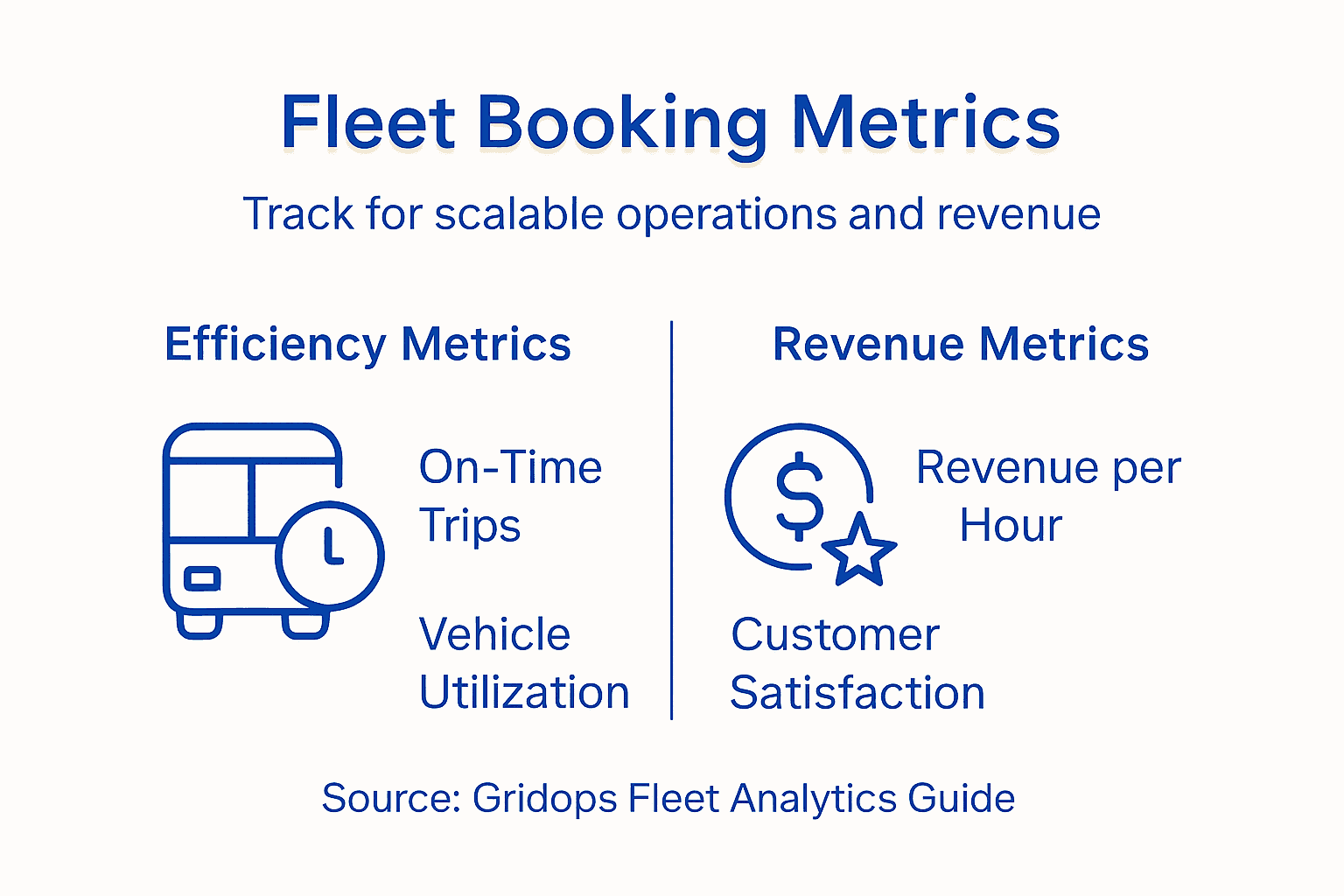
Next, analyze pricing performance across different dimensions. Which routes command the highest margins? When do customers book furthest in advance versus last-minute? How does pricing by day of week, season, or event type affect both volume and revenue? Data-driven decision making for pricing optimization enables you to identify patterns and adjust your strategy accordingly.
Segment your customer base to understand who drives the most value. Corporate clients, tour operators, event planners, and individual travelers have different booking patterns and price sensitivity. Tailor your offerings and pricing to each segment.
Look for untapped revenue opportunities through customer behavior analysis:
Peak demand periods where you could raise pricing without losing volume
Underutilized time slots that need aggressive pricing to fill capacity
High-value customer segments worth special attention
Routes with low margins that need restructuring
Seasonal trends you can capitalize on before competitors do
Use predictive analytics to forecast demand two to four weeks out. Historical data reveals patterns that let you anticipate busy periods and adjust supply or pricing preemptively. This beats reacting after the fact.
Create automated alerts when key metrics drift from targets. If cancellation rates spike, booking volume drops, or margin compression accelerates, you need to know immediately so you can adjust pricing or operations.
Analytics transforms guesswork into strategy. The operators who win are the ones measuring everything and acting on what the data reveals.
Actions to take this week:
Export your booking data from the last 90 days
Calculate margin by route, time slot, and customer type
Identify your top 10 and bottom 10 performing services
Compare actual pricing to your original strategy
Schedule weekly reviews of key metrics with your team
Pro tip: Start with one metric—like revenue per available vehicle hour—and track it obsessively for a month before adding more complexity; this forces you to understand what actually drives your business.
Step 4: Verify Operational Efficiency and Customer Experience
Now that your automation is live, you need to measure whether it’s actually delivering on its promises. This step shows you how to track the metrics that prove your system is running smoothly and keeping customers satisfied. Without verification, you’re flying blind.
Start by monitoring on-time performance. Track how many trips depart on schedule, arrive on time, and complete as promised. When automation handles dispatch and routing, your on-time rate should improve dramatically. If it’s not, your dispatch rules need adjustment or your vehicle capacity needs reassessment.
Next, measure customer satisfaction directly. Send post-trip surveys asking about booking ease, driver professionalism, vehicle condition, and overall experience. Your automated system should make booking effortless, but the actual service delivery is what builds loyalty. A customer who books easily but receives poor service becomes a detractor, not a promoter.
Track cancellation and no-show rates weekly. Automation reduces cancellations caused by communication failures, but customer-initiated cancellations tell you something about demand forecasting or pricing. Are customers canceling specific routes or time slots consistently? That signals a problem.
Operational effectiveness directly influences customer satisfaction and loyalty by optimizing how resources flow through every touchpoint. Your automation should improve both simultaneously. Monitor these interconnected metrics:
Below is a summary of core metrics for monitoring operational efficiency and customer experience:
Metric | What It Measures | Why It Matters |
|---|---|---|
On-Time Performance | Schedule reliability | Shows dispatch and routing quality |
Customer Satisfaction Score | Service quality feedback | Indicates loyalty and repeat business |
Cancellation/No-Show Rate | Booking fulfillment | Reveals demand or pricing issues |
Vehicle Utilization Rate | Fleet efficiency | Reflects profitability per asset |
Average Wait Time at Pickup | Convenience for clients | Affects client retention |
Average time from booking to confirmation
Driver assignment time after booking confirmation
Customer response rate to booking confirmations
Average wait time at pickup location
Vehicle utilization rate by time period
Customer satisfaction scores by vehicle and driver
Conduct monthly operational reviews with your dispatch and customer service teams. Ask what’s working, what’s breaking down, and what customers are complaining about. Frontline staff see problems your dashboard might miss.
Set improvement targets for each metric. If your on-time rate is 92 percent, aim for 96 percent next month. If satisfaction is 4.2 stars, target 4.5. Real improvement comes from focused attention on specific metrics, not vague goals.
Your automation only wins if customers and drivers actually experience the efficiency it promises. Measure relentlessly, act decisively.
Key verification actions:
Pull on-time performance data every week
Send automated satisfaction surveys after every trip
Review cancellation reasons to identify patterns
Monitor driver app engagement and notification response times
Compare customer ratings across your fleet
Schedule monthly reviews with operations staff
Pro tip: Focus on one metric per month—master it, improve it, then move to the next—rather than trying to optimize everything simultaneously and improving nothing.
Revolutionize Your Fleet Operations with Automated Efficiency
Managing fleet bookings, real-time dispatch, and dynamic pricing presents constant challenges that can drain time and cut into profits. If you struggle with manual reservation handling, pricing guesswork, or fragmented dispatch communications the “Scalable Fleet Operations Guide for Optimized Bookings” highlights exactly what needs to change for better results. Embracing automation and integrated analytics empowers your team to reduce errors, optimize revenue, and deliver superior customer experiences without being overwhelmed by complexity.

Discover how Gridops.ca can transform your charter or private transportation business into a smoothly connected, data-driven operation. Our Canadian-based SaaS platform offers instant automated bookings, dynamic pricing models, real-time dispatch optimization, and secure digital payments all in one scalable solution. Start by streamlining booking workflows and unlock advanced features like financial analytics and vehicle utilization tracking that fuel intelligent growth. Visit Gridops.ca now to take the first step toward smarter fleet management and sustained profitability.
Explore how our tools directly address the automation and operational efficiency keys outlined in the guide by visiting Gridops.ca. Make managing your fleet easier and your customers happier today.
Frequently Asked Questions
How can I automate my fleet booking processes?
To automate your fleet booking processes, start by selecting a platform that integrates with your existing systems and provides features like real-time availability updates and instant quote generation. Input your vehicle inventory details and configure pricing rules; aim to complete this setup within 30 days to start seeing improvements.
What are the benefits of integrating real-time dispatch and pricing?
Integrating real-time dispatch with pricing enables your system to match vehicle availability with customer demand perfectly. By employing adaptive pricing based on live data, you can optimize your revenue and ensure timely service delivery, which can lead to a ~20% increase in customer satisfaction and profitability.
What metrics should I track to verify operational efficiency?
To verify operational efficiency, you should track metrics like on-time performance, vehicle utilization rate, and customer satisfaction scores. Conduct monthly reviews of these metrics to identify trends and areas for improvement, focusing on increasing on-time performance by 4% each month.
How do I analyze customer behavior for revenue optimization?
Analyze customer behavior by segmenting your clientele into groups based on booking patterns and price sensitivity. By identifying high-value segments and their preferences, you can tailor your services and adjust pricing strategies to optimize revenue, potentially increasing it by ~15% over a quarter.
What steps can I take if I notice a spike in cancellation rates?
If you notice a spike in cancellation rates, investigate the reasons through customer feedback and data analysis. Adjust your pricing or service offerings based on the findings and implement targeted strategies to improve customer engagement and satisfaction, aiming to reduce cancellations by 10% within the next month.
Recommended